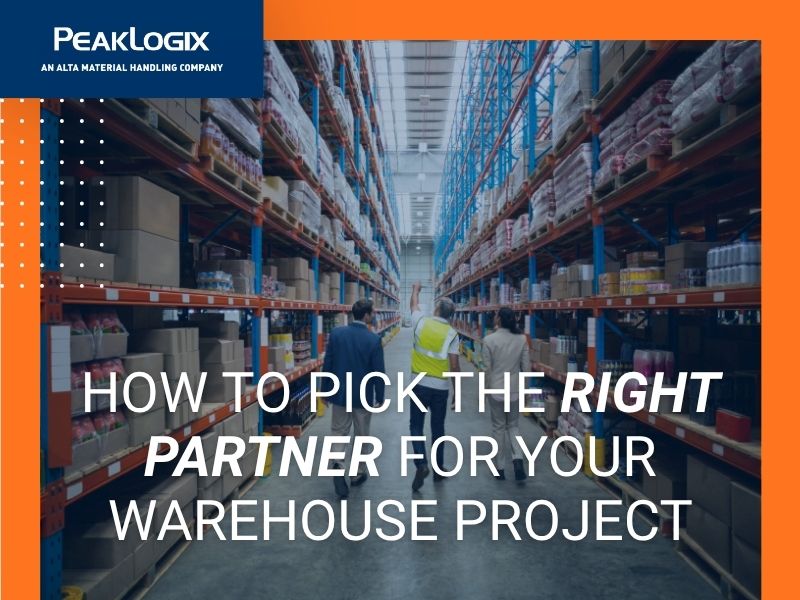
Six questions that separate the right partner from the wrong one — before you sign anything
Talk to four equipment vendors and you’ll get four different answers.
That’s not a coincidence — it’s the business model.
Most vendors recommend the solution they sell. Not the one your operation actually needs.
That’s why so many warehouse projects end up overbuilt, underperforming, or costing 2–3x more than expected.
Choosing the right partner isn’t about finding the most impressive technology. It’s about finding a team that can step back, understand your operation, and design the right system — even if that means recommending less automation, not more.
Before you move forward with any project, here are six questions worth asking.
- Are they recommending a solution — or solving your problem?
There’s a big difference.
If the conversation quickly turns into “you need this system”, you’re probably talking to a vendor. If it starts with “walk me through your operation”, you’re likely talking to a partner.
The right partner will spend more time understanding:
- Your throughput constraints
- Labor challenges
- SKU mix and variability
- Seasonal spikes
- Facility limitations
Only then will they start talking about solutions.
If you’re seeing the same recommendation regardless of your answers, that’s a red flag.
A good place to start is understanding how a thoughtful approach to warehouse logistics automation actually begins — with your operation, not the equipment.
- Do they offer multiple technologies — or just one?
Every warehouse is different. So why would one technology always be the answer?
Strong partners aren’t tied to a single manufacturer or system. They pull from a range of options — from conveyor systems to robotics, software, and high-density storage — and build the right combination for your operation.
That flexibility matters.
Because sometimes the best answer isn’t a robot.
Sometimes it’s fixing a bottleneck upstream.
Sometimes it’s improving flow before adding automation.
If your “partner” only sells one thing, you already know what they’re going to recommend.
- Can they design the entire system — not just a piece of it?
Warehouse performance doesn’t come from individual components. It comes from how everything works together.
You can have the best robot in the world — but if your conveyor can’t feed it properly, or your software can’t keep up, it won’t deliver results.
The right partner looks at the entire system — from inbound to shipping — and designs how everything connects.
That includes:
- Equipment
- Software
- Controls
- Material flow
It’s the difference between buying parts and building a system. You can see how this comes together in a complete warehouse solutions approach rather than a single piece of equipment.
- What happens after installation?
This is where many projects fall apart.
Some vendors disappear once the equipment is installed. Others hand you off to a support team that didn’t design the system in the first place.
A true partner stays involved:
- Installation and commissioning
- Operator training
- System optimization
- Ongoing support
Because the real work starts after go-live.
Your operation will evolve. Volumes will change. New challenges will come up. You want a partner who’s still there when that happens — not just during the sale.
This long-term mindset is what separates vendors from companies focused on building lasting warehouse partnerships.
- Can they show real results — not just concepts?
Every company has a slick presentation. That’s easy.
What matters is whether they’ve done it before — in environments like yours.
Ask for:
- Real project examples
- Throughput improvements
- Labor reduction metrics
- Customer references
Especially within food & beverage, where requirements around sanitation, temperature control, and traceability add complexity.
If you’re evaluating options, reviewing real-world insights and examples — like those found in the PeakLogix resource library — can help you separate proven results from theory.
If they can’t point to real outcomes, you’re taking on unnecessary risk.
- Are they helping you avoid overbuilding?
More automation isn’t always better.
In fact, one of the most common (and expensive) mistakes is overbuilding — adding complexity and cost where it’s not needed.
A good partner will push back when appropriate.
They’ll help you phase investments.
They’ll identify what actually drives ROI — and what doesn’t.
Sometimes the smartest move is starting smaller, fixing the biggest constraint, and scaling from there.
If you’re unsure where to begin, a practical starting point is understanding where to start with warehouse automation — and what actually delivers impact early.
That kind of thinking saves money upfront — and prevents costly redesigns later.
The Bottom Line
The success of your warehouse project has less to do with the equipment you choose — and more to do with who you choose to design it.
The wrong partner will sell you what they have.
The right partner will build what you need.
That’s the difference between a system that looks good on paper… and one that actually works on your floor.
Before you sign anything, make sure you’re asking the right questions.
Because getting this decision right the first time is what keeps your project on budget, on schedule — and delivering results long after installation.
