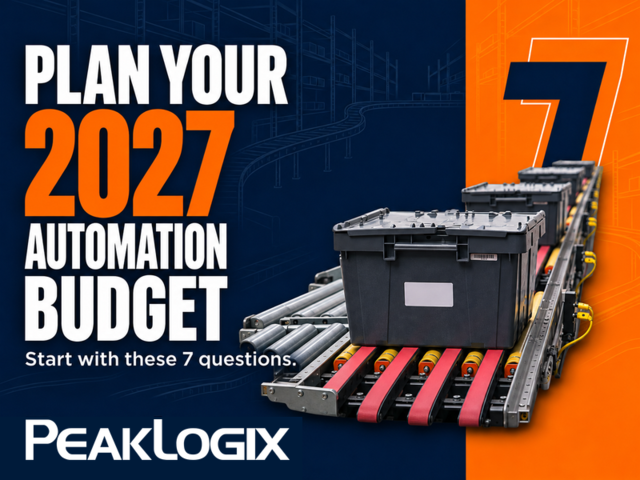
As warehouse and distribution leaders prepare their 2027 capital budgets, rising labor costs, limited warehouse space, and increasing throughput demands are making automation an important investment consideration.
But effective warehouse automation budget planning starts with understanding your operation—not selecting equipment.
Whether you’re considering a complete system upgrade or targeted improvements, these seven questions can help you identify priorities, estimate costs, and build a stronger business case for 2027.
1. What Operational Challenges Are Costing Us the Most?
Start by identifying your biggest operational bottlenecks. Are picking delays affecting fulfillment? Are manual processes creating errors? Is inefficient material flow limiting productivity?
Review key performance indicators, including order accuracy, downtime, travel time, and cost per order.
Understanding these challenges provides the foundation for evaluating potential warehouse automation solutions and determining where investment could deliver the greatest impact.
2. What Are Our True Labor Costs?
Labor expenses extend beyond hourly wages. Overtime, recruitment, training, turnover, and temporary staffing can significantly increase operating costs.
Calculate your fully loaded labor expenses and identify repetitive, labor-intensive tasks.
Automation can help reduce unnecessary travel, increase productivity, and allow employees to focus on higher-value work.
For additional guidance, read How to Build the Business Case for Warehouse Automation.
3. Are We Maximizing Our Existing Warehouse Space?
Before budgeting for facility expansion, evaluate whether your existing space can support future growth.
Consider storage density, aisle configurations, pallet positions, SKU locations, and unused vertical space.
Solutions such as warehouse racking, vertical lift modules, and automated storage and retrieval systems (AS/RS) may help increase capacity without expanding your footprint.
4. Can We Handle Projected 2027 Throughput?
Today’s performance may not support tomorrow’s demand.
Evaluate anticipated order growth, seasonal peaks, SKU expansion, and changing customer requirements.
Compare current throughput against projected volume to identify potential bottlenecks in picking, replenishment, sortation, and shipping.
These findings help determine which operational improvements should receive priority in your 2027 capital budget.
Planning Your 2027 Warehouse Automation Investments?
Before selecting equipment or requesting proposals, organize your operational challenges, growth projections, and investment priorities.
Explore PeakLogix’s Warehouse Automation & Storage Budget Planner to begin preparing your capital budget.
5. Which Automation Investments Should Come First?
You don’t need to automate everything to achieve meaningful improvements.
Consider starting with processes that offer measurable operational benefits, such as repetitive transportation, high-volume picking, or inefficient pallet storage.
Potential investments include conveyor systems, goods-to-person solutions, autonomous mobile robots, and higher-density storage.
Prioritize projects based on operational impact, implementation complexity, scalability, and expected return on investment.
As explained in You Don’t Have to Automate Everything to Win Big, phased automation can provide an achievable path toward long-term improvements.
6. Have We Accounted for All Implementation Expenses?
Equipment represents only part of a warehouse automation investment.
Your budget should also consider engineering, installation, software integration, facility modifications, training, testing, and ongoing maintenance.
Implementation timelines and potential operational disruptions should also factor into your financial planning.
A complete cost assessment helps prevent unexpected expenses and supports a more realistic ROI calculation.
Learn more in Calculating the ROI of Warehouse Automation.
7. What Preliminary Investment Range Makes Sense?
Before requesting detailed proposals, consider developing a Rough Order of Magnitude (ROM) estimate.
A ROM provides an early investment range based on your operational requirements, capacity goals, and potential automation approaches.
It isn’t a final quote. Instead, it helps leadership understand the approximate financial commitment and determine whether a project aligns with business objectives.
Read Why a Rough Order of Magnitude Belongs in Every Warehouse Automation Budget Conversation for additional guidance.
Turn Your 2027 Automation Priorities Into a Budget Plan
Successful warehouse automation planning begins with clear priorities, reliable operational data, and realistic investment expectations.
PeakLogix’s Warehouse Automation & Storage Budget Planner provides a starting point for organizing your priorities and preparing for capital budget discussions.
Use the planner to begin evaluating your needs, then connect with PeakLogix to explore practical solutions for your operation.
Start Planning Your 2027 Warehouse Automation Budget
Frequently Asked Questions About Warehouse Automation Budgeting
How do you budget for warehouse automation?
Start by assessing current operating costs, labor requirements, storage utilization, and throughput. Identify improvement opportunities, estimate implementation expenses, and prioritize projects based on potential ROI and business objectives.
What costs should be included in a warehouse automation project?
Include equipment, engineering, installation, software integration, facility modifications, training, ongoing maintenance, and potential operational disruptions. Consider the total cost of ownership rather than equipment pricing alone.
What is a ROM estimate in warehouse automation?
A Rough Order of Magnitude (ROM) estimate is a preliminary investment range used during early project planning. It helps organizations evaluate financial feasibility before committing to detailed engineering or formal proposals.