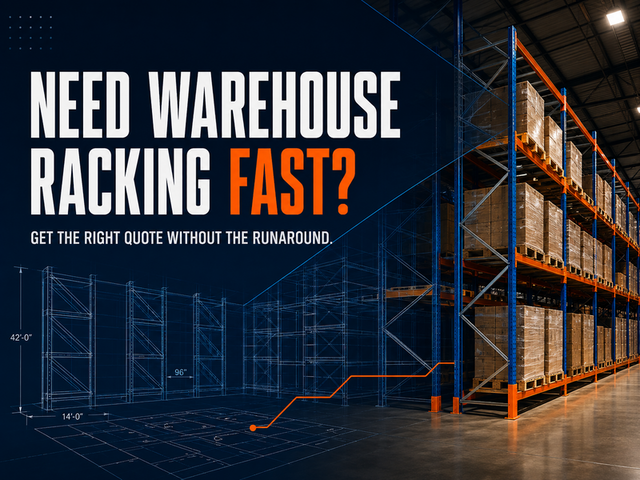
When your facility needs new warehouse racking, getting a price shouldn’t take weeks.
Yet many companies discover that requesting a warehouse racking quote is more complicated than expected. One company designs the system. Another supplies the rack. Someone else handles installation. Before you have a complete number, you may be coordinating with multiple vendors, and the initial estimate may not reflect the actual cost of the finished project.
There’s a simpler way.
PeakLogix provides warehouse equipment and material handling solutions with an integrated approach to design, sourcing, and implementation. Instead of piecing together separate parts of the project, your team can work with one partner to determine the right racking system and move from concept to quote faster.
Why Warehouse Racking Quotes Can Take So Long
Racking isn’t simply a matter of calculating how many uprights and beams fit into a building.
The right system depends on how your facility actually operates, including:
- Pallet and product dimensions
- SKU mix and inventory levels
- Product movement and rotation
- Forklift and aisle requirements
- Picking and replenishment processes
- Available floor and vertical space
- Current and future capacity requirements
These variables affect both the type of rack you need and the overall project cost.
That’s why PeakLogix takes a solution-based approach. Its warehouse design services evaluate facility requirements, material flow, and operational data before developing a solution.
The goal isn’t to sell you as much rack as possible. It’s to determine what actually makes sense for your operation.
One Team. One Racking Quote. One Complete Project.
Working with separate designers, equipment suppliers, and installers creates more than administrative headaches. It can create gaps in project scope.
A low initial equipment price may look attractive until installation, design changes, freight, or other project requirements are added later.
A turnkey approach helps eliminate those disconnects.
PeakLogix works across the project, from evaluating the application and designing the solution to sourcing equipment, integration, and implementation. That means you get a clearer picture of the complete racking investment instead of a starting number that may change significantly as the project moves forward.
For facilities working against expansion deadlines, capacity constraints, or operational changes, getting to a reliable number quickly can make planning much easier.
Which Warehouse Racking System Is Right for Your Facility?
There isn’t one “best” warehouse racking system. The right choice depends on your inventory and how product needs to move through the facility.
Depending on the application, your solution could include selective pallet racking, double-deep racking, drive-in racking, push-back racking, pallet flow, carton flow, cantilever racking, or pallet shuttle systems.
For example, selective pallet rack provides direct access to individual pallet positions and works well for operations with a broad SKU mix. Higher-density solutions can make better use of available space when direct access to every pallet isn’t required. Flow systems can support inventory rotation and picking applications, while cantilever racks can accommodate long or irregularly shaped materials.
Racking can also become part of a larger fulfillment strategy. PeakLogix’s guide to pick modules in warehouse design explains how pallet flow, carton flow, push-back rack, conveyors, and other technologies can work together to create more efficient picking environments.
The important question isn’t “Which rack holds the most product?”
It’s “Which racking system best supports the way our product moves?”
Better Racking Starts With Better Facility Planning
The right racking design can do more than create pallet positions. It can help increase storage density, improve material flow, support safer operations, reduce unnecessary travel, and potentially delay the need for additional facility space.
PeakLogix has been helping manufacturing, distribution, and material handling operations improve efficiency since 1989. Its broader material handling approach considers how storage, equipment, software, automation, and operational processes work together.
That matters because your racking shouldn’t be designed in isolation. It needs to work with the rest of your facility.
Ready for a Warehouse Racking Quote?
If you already know you need racking, you shouldn’t have to spend weeks chasing vendors just to understand what the project could cost.
Tell PeakLogix about your facility, available space, product mix, and storage requirements. The team can help determine the right system and provide a quote based on the needs of the complete project.
Get a real number—not a runaround.
