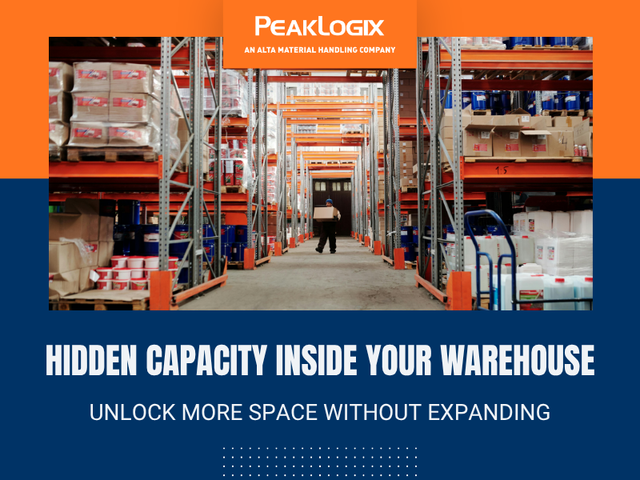
When warehouse space starts becoming a problem, many operations leaders immediately assume they need more racking, more square footage, or even a larger building.
But what if the space you need is already there?
Across manufacturing, distribution, food and beverage, and wholesale operations, warehouses often have hidden capacity sitting in plain sight. Unused vertical space, inefficient layouts, damaged racking, and outdated storage strategies can prevent facilities from reaching their full potential.
Before investing in a building expansion or leasing additional space, it is worth taking a closer look at your current operation. Many warehouses can unlock significant storage capacity without adding a single square foot.
The Hidden Cost of Unused Warehouse Space
Most warehouses run out of floor space long before they run out of storage opportunities.
As inventory grows, pallets begin appearing in staging areas, aisles become congested, and available storage locations become harder to find. At that point, many organizations assume their facility is full.
However, the reality is often different.
Many operations are not fully utilizing their vertical space. Facilities frequently have unused cube above existing storage locations that could support additional pallet positions through properly designed warehouse racking systems.
This hidden capacity often represents one of the fastest and most cost effective opportunities to increase storage density. Instead of expanding outward, businesses can often maximize the footprint they already own.
How Many More Pallets Could You Fit Today?
It is a simple question, but one that many warehouse operators cannot answer with confidence.
Many facilities have more available storage capacity than they realize. Through warehouse layout improvements, rack reconfiguration projects, and smarter storage design, companies often uncover opportunities to increase capacity by 20 to 30 percent without expanding their buildings.
The key is understanding where those opportunities exist.
A professional warehouse assessment can help identify underutilized storage locations, inefficient aisle spacing, poor inventory positioning, and opportunities to improve overall space utilization.
These insights allow operations leaders to make informed decisions before investing in additional racking, new facilities, or costly expansion projects.
Is Your Warehouse Layout Holding You Back?
Warehouses evolve over time.
New products are introduced. Inventory profiles change. Customer demand increases. Throughput requirements grow.
Unfortunately, many warehouse layouts do not evolve at the same pace.
A layout that worked well several years ago may now be limiting capacity, increasing travel time, and creating unnecessary bottlenecks throughout the operation.
Strategic warehouse reconfiguration can often improve both storage density and operational efficiency. By evaluating product flow, storage locations, and rack configurations, organizations can create a warehouse environment that better supports current and future business needs.
The team at PeakLogix works with companies across a variety of industries to identify practical opportunities for improving warehouse performance while maximizing available storage space.
Rack Damage May Be Costing More Than You Think
Storage capacity is not the only factor impacting warehouse performance.
Damaged racking can reduce usable storage positions, create safety concerns, and increase operational risk.
Forklift impacts are common in active warehouse environments. Over time, even minor damage to uprights, beams, or structural components can affect system performance and compromise safety.
Ignoring damaged rack can lead to reduced storage capacity, compliance concerns, inventory damage, and unplanned downtime.
Regular inspections and timely repairs help protect both employees and inventory while maintaining the integrity of the storage system.
Through its warehouse rack repair and service solutions, PeakLogix helps organizations identify damage, restore storage system performance, and maintain safe operating environments.
Before You Invest in More Racking, Understand Your Options
One of the biggest misconceptions in warehouse management is that every storage challenge requires additional racking.
Sometimes that is the right solution.
Often it is not.
Many operations can unlock substantial storage gains through better layouts, rack reconfiguration, improved slotting strategies, and more effective space utilization. In many cases, the answer is not adding more equipment but optimizing what already exists.
For facilities looking to improve long term efficiency, warehouse storage optimization can also serve as the foundation for future warehouse automation solutions, creating a more scalable operation as demand continues to grow.
Start With an Assessment
Before committing to a warehouse expansion, additional storage systems, or major capital expenditures, it is important to understand the true potential of your existing facility.
Many organizations discover opportunities such as additional pallet positions hidden within their current footprint, unused vertical storage capacity, layout improvements that increase throughput, damaged racking that is limiting performance, reconfiguration opportunities that support future growth, and more efficient storage and engineered products that improve space utilization.
The most successful warehouse improvement projects start with a clear understanding of current conditions and future requirements.
The Bottom Line
Running out of warehouse space does not automatically mean you need a larger building.
Many facilities are sitting on hidden capacity that can be unlocked through better storage design, warehouse layout improvements, rack repairs, and strategic reconfiguration.
Before investing in expansion, take the time to understand what is possible within your existing operation.
The space you need may already be inside your warehouse.
