
Key Takeaways
- Picking accounts for 55% of warehouse operating costs and up to 55% of a picker’s time is spent traveling — not picking. Goods-to-person (GTP) systems eliminate most of that travel.
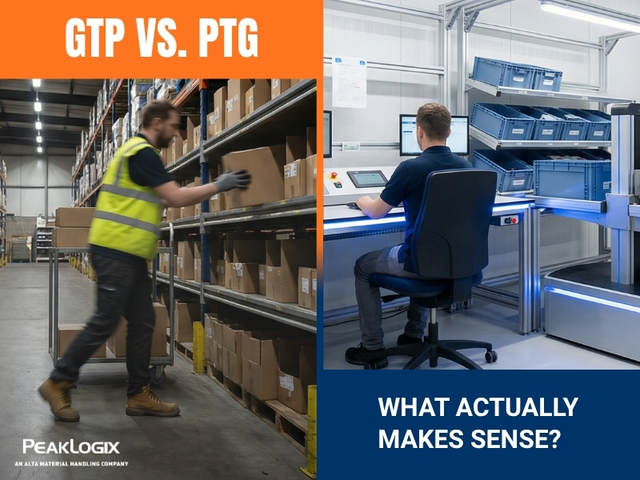
- GTP systems bring inventory to a stationary operator; person-to-goods (PTG) requires the operator to travel to the inventory. The choice between them drives nearly every other decision in your fulfillment design.
- GTP delivers 200–800+ picks per operator per hour — 3–8× more than manual PTG picking — and accuracy rates above 99.9%.
- GTP is not always the right answer. PTG remains optimal for lower-volume operations, wide SKU variety with infrequent velocity, or facilities where capital investment is constrained.
- The real question isn’t GTP vs. PTG — it’s which zones of your facility benefit from each model, and how to integrate them.
Order picking is the most labor-intensive and expensive activity in a warehouse. It accounts for more than half of total warehouse operating costs — and in a traditional person-to-goods environment, pickers spend more time walking than picking.
Research from the Georgia Tech Supply Chain and Logistics Institute shows that 55% of a picker’s time is spent traveling to item locations — followed by searching (15%), extracting (10%), and paperwork (20%). Only about 10% of a picker’s shift is spent on the actual act of picking. (NetSuite/Georgia Tech)
Goods-to-person (GTP) technology inverts that equation. Instead of sending people to find products, automated systems deliver products to stationary operators — eliminating most of the travel, reducing error, and dramatically increasing throughput per head.
But GTP isn’t a universal answer. The right fulfillment model depends on your order profile, SKU mix, throughput requirements, and capital position. This guide lays out the practical framework for deciding which model — or combination of models — makes sense for your operation.
What Is Goods-to-Person Fulfillment?
Goods-to-person is a fulfillment approach where automated storage and retrieval systems bring inventory containers, totes, or trays directly to an operator workstation. The operator never leaves their station — the system does the travel.
The most common GTP technologies include:
Vertical Lift Modules (VLMs) — vertical automated storage units that retrieve trays of inventory to an operator opening at an ergonomic working height. VLMs are among the most widely deployed GTP technologies for parts, healthcare, and mixed-SKU distribution.
Horizontal and Vertical Carousels — rotating storage units that bring the right shelf to the operator. Horizontal carousels are commonly deployed in multi-unit configurations (pods) to maximize throughput at a single workstation.
AS/RS Mini-Load and Shuttle Systems — high-density automated systems that store and retrieve totes or cartons at high speed. AS/RS systems deliver the highest throughput of any GTP technology and are typically deployed in large-scale distribution and e-commerce fulfillment operations.
AMR-Based GTP — autonomous mobile robots that transport shelving pods or totes to stationary pick stations. This model offers greater flexibility than fixed infrastructure GTP and is increasingly common in e-commerce and 3PL environments.
What Is Person-to-Goods Fulfillment?
Person-to-goods (PTG) is the traditional warehouse picking model: a picker receives a pick list or WMS direction, travels through the warehouse to item locations, picks the items, and returns. It encompasses every picking method where the human moves to the inventory — including discrete picking, batch picking, zone picking, and wave picking.
PTG is not inherently inefficient. For many operations, it remains the most cost-effective and flexible approach — particularly when:
- Order volumes are moderate and SKU counts are low to medium
- The product mix changes frequently and reslotting a GTP system would be disruptive
- Building constraints prevent the installation of tall, automated storage units
- Capital investment needs to remain minimal in the near term
The problem with PTG at scale is that labor costs, error rates, and travel time all grow proportionally with volume. GTP separates throughput from headcount.
GTP vs. PTG: Side-by-Side Comparison
| Goods-to-Person (GTP) | Person-to-Goods (PTG) | |
| Best for | High-volume, high-SKU, e-commerce, omnichannel | Lower volume, wide aisles, infrequent SKU mix |
| Labor intensity | Low — system brings items to operator | High — pickers travel to items |
| Floor space | Compact — up to 85% space savings vs. shelving | Requires wide pick aisles throughout |
| Throughput | 200–800+ picks/hour per operator | 50–100 picks/hour per operator (typical) |
| Accuracy | 99.9%+ with barcode/light confirmation | 97–98% average; errors scale with volume |
| Capital investment | Higher upfront; ROI typically 12–24 months | Lower upfront; higher ongoing labor cost |
| Flexibility | Best for stable, high-velocity SKUs | Easier to reconfigure for changing SKU mix |
| WMS/WCS required | Yes — tight integration essential | Standard WMS sufficient |
When Goods-to-Person Wins
GTP delivers its strongest ROI when picking volume is high, SKU mix is stable, and labor is the primary cost driver. McKinsey research documents 200%+ picking productivity improvements in operations that have implemented GTP correctly — with the most significant gains in operations previously relying on manual PTG at scale. (McKinsey)
The specific conditions that favor GTP:
- High order volume with repetitive SKU access patterns — the system pays for itself through labor savings
- High pick accuracy requirements — food, pharmaceutical, healthcare, and medical device operations where errors carry compliance risk
- Space-constrained facilities — GTP systems typically use 40–85% less floor space than equivalent static shelving
- Labor market pressure — when qualified pickers are difficult to recruit or retain, reducing your dependency on high-headcount picking is a structural advantage
- E-commerce and omnichannel fulfillment — where order profiles are small, frequent, and varied, and throughput windows are compressed
The Wacoal case study on PeakLogix’s site is instructive: implementing horizontal carousels increased their pick rate by 178% and reduced pick labor by 84% — in the same facility footprint.
When Person-to-Goods Still Makes Sense
GTP systems require significant capital investment, careful SKU velocity analysis, and integration with WMS/WCS software. For many operations, PTG — optimized with good slotting, zone design, and picking technology — is the better near-term answer.
PTG is the better fit when:
- Average order sizes are large (full-case or pallet-level picking vs. each-level) — GTP’s ergonomic advantage is less relevant for full-case work
- SKU counts are low and items are large or irregularly shaped — not suited for tote-based GTP systems
- The facility has low ceilings that prevent VLM or tall AS/RS installation
- Volume is too low to justify the capital outlay for full GTP infrastructure
- The operation is in early growth and needs flexibility to scale in multiple directions
In many mature distribution facilities, the answer is a hybrid: GTP zones for high-velocity, small-unit SKUs alongside PTG zones for bulk, irregular, or slow-moving product.
The Hybrid Model: Zoning Your Warehouse for Both
Most real-world fulfillment operations with significant SKU breadth aren’t a pure GTP or pure PTG environment — they’re a thoughtful combination of both, designed around velocity tiers.
A common hybrid architecture:
A-tier SKUs (top 10–20% of volume) → GTP zone: VLMs, carousels, or AS/RS for the highest-velocity items where automated retrieval delivers the fastest ROI
B-tier SKUs (middle velocity) → AMR-assisted picking or zone picking with pick-to-light for medium-velocity items that don’t justify full GTP infrastructure
C-tier SKUs (slow movers, bulk items) → PTG zones: standard selective racking with WMS-directed discrete or batch picking
The glue holding all of this together is WMS/WCS integration — specifically, a warehouse control system that can orchestrate work across GTP zones, AMR fleets, and PTG aisles simultaneously, balancing workload and minimizing bottlenecks.
5 Questions to Answer Before Choosing a Fulfillment Model
- What is your picks-per-day volume, and where is it heading?
The business case for GTP improves significantly above 500–1,000 picks per day. Below that threshold, PTG optimization often delivers better ROI for the same capital.
- What does your order profile look like?
Multi-line, each-level orders favor GTP. Single-line, full-case orders favor PTG. Mixed profiles often benefit from a hybrid approach zoned by velocity tier.
- What are your ceiling height and floor space constraints?
VLMs and tall AS/RS systems require 15–40+ foot clear heights. Low-ceiling facilities may be limited to horizontal carousels, AMR-based GTP, or PTG with optimized slotting.
- How stable is your SKU mix?
GTP systems are optimized for high-velocity, predictable SKU sets. Operations with frequent product line changes, seasonal reversals, or wide long-tail SKU sets may need more flexible PTG infrastructure.
- What does your labor market look like — and what’s your 3-year trajectory?
If labor availability or cost is a growing constraint, GTP’s ability to multiply throughput per operator head is a structural hedge. If your operation has stable, experienced labor at manageable cost, PTG optimization may close the gap without the capital outlay.
Not Sure Which Model Fits Your Operation?
PeakLogix has designed GTP and hybrid fulfillment systems across hundreds of operations — from medical device distributors achieving 47% productivity gains and $1.3M in annual savings to retail distributors doubling shipping throughput without adding floor space. Every project starts with your actual order profile, not a technology preference.
Whether you’re evaluating a full GTP implementation, a hybrid redesign, or simply trying to understand whether your current PTG setup can be optimized to delay a larger capital investment — we can help you work through the numbers.
→ Contact PeakLogix to schedule a free warehouse design consultation.
Frequently Asked Questions
What is a goods-to-person system?
A goods-to-person (GTP) system is an automated fulfillment approach where storage equipment — such as vertical lift modules, carousels, or AS/RS systems — retrieves and delivers inventory containers to a stationary operator workstation. The operator picks the required items as they are presented, rather than traveling through the warehouse to locate them. GTP systems dramatically reduce travel time, improve accuracy, and increase picks per operator per hour.
What is the difference between goods-to-person and person-to-goods?
In goods-to-person (GTP) fulfillment, automated systems move inventory to a stationary picker. In person-to-goods (PTG), the picker travels through the warehouse to item locations. The key difference is who does the traveling: in PTG, the picker walks; in GTP, the system retrieves. GTP significantly reduces travel time — typically the largest single component of pick time in a manual warehouse — and enables higher throughput per operator.
How many picks per hour can a goods-to-person system achieve?
GTP throughput varies by technology. VLM-based systems typically enable 200–400 picks per operator per hour. Carousel pod configurations commonly achieve 400–600+ picks per hour. High-throughput AS/RS mini-load systems can exceed 800 picks per operator per hour in optimally configured environments. By comparison, manual person-to-goods picking in a well-organized warehouse typically yields 50–120 picks per hour depending on the operation.
What types of operations benefit most from goods-to-person systems?
GTP delivers the strongest ROI in operations with high daily pick volumes (typically 500+ picks per day), each-level or small-unit picking, high accuracy requirements, and stable high-velocity SKU sets. Common industries include healthcare and medical devices, pharmaceutical distribution, e-commerce fulfillment, electronics, and cosmetics. Operations with full-case or pallet-level picking, very wide or irregular product dimensions, or low daily volumes often achieve better returns through optimized PTG or hybrid approaches.
Can goods-to-person and person-to-goods coexist in the same facility?
Yes — and for most operations with broad SKU breadth, a hybrid model is the most cost-effective design. High-velocity, small-unit SKUs are assigned to GTP zones where automated retrieval delivers the fastest ROI. Medium-velocity items may be handled with AMR-assisted picking or pick-to-light. Slow-moving, bulk, or irregular SKUs remain in PTG zones. A warehouse control system orchestrates work across all zones simultaneously to balance throughput and eliminate bottlenecks.
What WMS or WCS integration is required for a GTP system?
GTP systems require integration between the automated storage equipment and the facility’s warehouse management system (WMS) or warehouse control system (WCS). The WMS or WCS directs the GTP system to retrieve specific totes or trays, presents pick instructions to the operator at the workstation, confirms the pick, and updates inventory in real time. The tighter this integration, the higher the achievable accuracy and throughput. PeakLogix’s ScottTech PICKPro® WMS is designed for exactly this type of multi-technology orchestration across GTP zones, conveyors, and PTG aisles.
