Learn how operations teams identify material flow bottlenecks before investing in robotics
Food and beverage companies are under pressure to move faster than ever. Production lines are becoming more efficient. Order volumes continue to rise. Customers expect shorter delivery windows and near perfect accuracy. As a result, many operations leaders immediately start exploring robotics as the answer.
But here’s the problem. A robot will not solve a broken material flow process.
Many food and beverage facilities invest heavily in robotics only to discover the real issue was happening upstream all along. Cases were backing up before reaching the robot. Shipping lanes were congested. Operators were manually rerouting products because the system could not keep up. The robot itself worked perfectly, but the overall operation still struggled.
That’s why the most effective operations teams evaluate how products move throughout the facility before committing to robotics. In many cases, the biggest gains come from improving conveyor systems, sortation, and controls first — and that’s exactly where PeakLogix starts every engagement.
Most Bottlenecks Start Before the Robot
When a facility experiences delays in packing or shipping, robotics often become the first thing people talk about. But the underlying issue is usually inconsistent product flow.
This is especially common in food and beverage operations where facilities are handling high SKU counts, seasonal demand spikes, strict sanitation requirements, and fast moving production schedules all at once.
Products may arrive unevenly to packing stations. Shipping teams may struggle to sort outbound orders efficiently. Pallets may sit waiting because the next process cannot keep pace. Operators begin stepping in manually just to keep orders moving.
At that point, adding robotics without fixing the flow only increases the speed of the bottleneck.
Conveyor Systems Are More Strategic Than Most People Realize
Many people still think of conveyors as simple transportation equipment.
In reality, conveyors play a major role in warehouse efficiency, especially in food and beverage environments where consistent throughput matters.
A well designed food safe conveyor system helps regulate the pace of the operation. Instead of relying on manual movement between processes, products flow continuously and predictably throughout the facility. That consistency improves throughput while reducing congestion, labor strain, and unnecessary handling.
For food and beverage facilities, conveyor design becomes even more important because systems must support washdown environments, moisture exposure, temperature controlled zones, and sanitation requirements. Equipment that works in a standard warehouse environment may not hold up in a food grade operation.
With more than 35 years of experience designing material handling systems, PeakLogix approaches every project as a brand-agnostic integrator — focused on what the operation actually needs, not on moving a specific product.
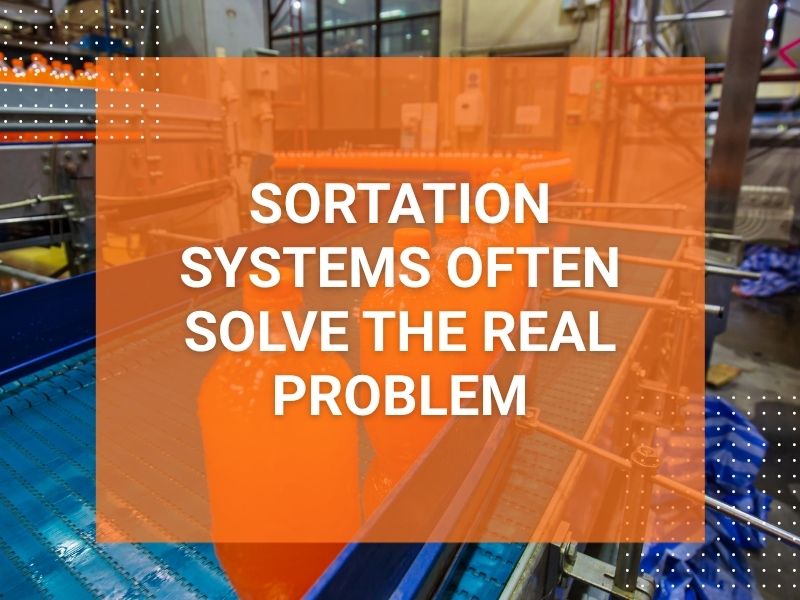
Sortation Systems Often Solve the Real Problem
One of the most overlooked bottlenecks in food and beverage operations is sorting.
As order volumes increase, manually directing cartons to the correct shipping lane or staging area becomes difficult to manage efficiently. Small delays begin compounding throughout the operation. Packing stations back up. Shipping accuracy suffers. Labor requirements increase.
This is where sortation systems can completely change the flow of the operation. Instead of relying on operators to manually route products, sortation automatically directs cases and cartons to the correct destination using barcode scanning, sensors, and intelligent controls.
For many food and beverage companies, improving sortation creates a bigger operational impact than robotics initially would have. Shipping becomes more organized. Packing stays balanced. Throughput increases because products are no longer getting trapped in manual processes.
The Best Automation Strategies Start With Visibility
The most successful operations leaders spend time identifying where products slow down, where manual workarounds occur, and where flow becomes inconsistent throughout the day. Sometimes the issue is labor. Sometimes it is equipment. But very often, it is communication between systems.
That’s why warehouse controls systems are becoming increasingly important in food and beverage automation. Controls allow conveyors, sortation systems, scanners, and equipment to work together as a connected operation rather than individual pieces of equipment.
Without that visibility and coordination, even expensive automation struggles to deliver consistent results.
The Bottom Line
Robotics have a place in food and beverage automation. But the facilities seeing the best results are not starting with robots first. They are starting with flow.
They improve the foundation first — conveyors, sortation, controls, and system integration — then layer in advanced automation where it actually makes sense.
If you want to know where your operation stands, start with the PeakLogix Warehouse Assessment.
