Key Takeaways
- Unplanned warehouse downtime costs industrial operations $100,000 or more per hour — before emergency labor, SLA penalties, and cascading losses are factored in.
- Reactive maintenance (run-to-fail) costs up to 40% more than planned maintenance approaches over time, even when it appears cheaper upfront.
- The three maintenance approaches — reactive, preventive, and predictive — have very different risk/cost profiles. The right choice depends on your system complexity and uptime requirements.
- Automated systems require structured maintenance programs. Conveyors, AS/RS, VLMs, and AMRs all have specific PM schedules that protect ROI and extend operational life.
- Response time matters as much as maintenance quality. A 24/7 service agreement with guaranteed response windows is the difference between a contained incident and a multi-day disruption.
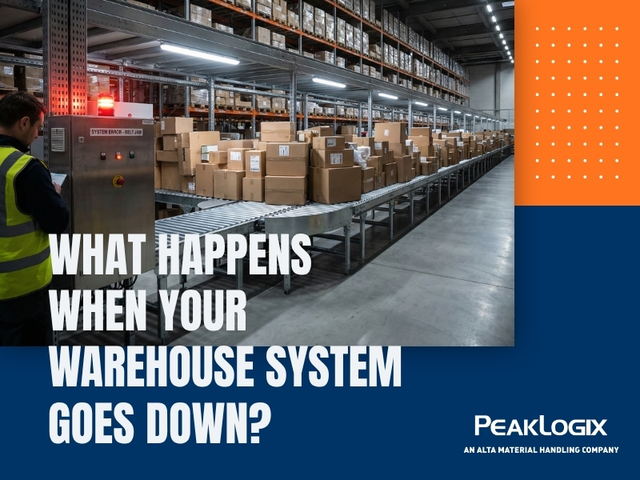
It starts with a single conveyor jam. Then the pick-and-pass system backs up. Within 20 minutes, the dock doors are stalled, the shift supervisor is calling the vendor, and no one has a clear picture of when the system will be back up.
If you operate an automated warehouse, this isn’t a hypothetical. Industry research consistently puts unplanned downtime costs for industrial operations at $100,000 or more per hour once you account for lost throughput, emergency labor, SLA penalties, and cascading labor costs. An eight-hour shift-length outage at that rate crosses $1 million before the repair tech even arrives.
And yet a significant share of facilities still operate on a run-to-fail strategy — waiting for something to break before addressing it. According to the Society for Maintenance & Reliability Professionals (SMRP), reactive-only maintenance costs up to 3–9× more per repair event than planned maintenance programs.
This post is about why that math doesn’t work, what a genuine maintenance program looks like for a modern automated facility, and what to look for in a service partner that can actually keep you running.
The Real Cost of Downtime (It’s Not Just the Repair Bill)
When operations leaders think about downtime costs, they almost always underestimate them. The repair bill is visible — the rest isn’t.
Here’s what the full cost picture actually looks like when a critical system goes down:
Immediate production loss — Every hour an automated system is down is an hour of orders not picked, shipments not processed, and dock doors not moving. For operations running two or three shifts, even a 4-hour mid-shift outage can take a full day of overtime to recover from.
Emergency labor costs — Unplanned repairs happen at the worst times. Emergency technician rates run 1.5–2× standard rates. If the right part isn’t on-site, you’re paying expedited shipping on top of that.
SLA and penalty exposure — For 3PLs and retail distribution operations, missed delivery windows have contractual consequences. A 4-hour outage during peak season can trigger chargebacks that dwarf the repair cost.
Cascading labor costs — Your warehouse staff doesn’t disappear when the system goes down. They’re still clocked in, standing by, often unable to process orders manually at anything close to normal throughput.
Untracked losses — Most operations underestimate their true downtime cost because they only track the repair invoice. According to reliability engineering firm IDCON, the hidden costs of poor maintenance — including overtime, expediting, lost throughput, and quality escapes — typically run 4–15× the direct repair cost.
“If you don’t plan for maintenance, your machine will plan it for you.” — A principle that applies to every conveyor, every crane, every VLM in your facility.
The Three Maintenance Strategies — And What Each One Actually Costs
Not all maintenance programs are equal. The strategy you choose determines your downtime frequency, your repair costs, and ultimately, your total cost of ownership on your automation investment.
Reactive Maintenance (Run-to-Fail)
Wait for a failure. Fix it. Repeat.
This appears to be the cheapest approach because there’s no upfront program cost. In reality, it’s the most expensive strategy available.
Emergency repairs cost 4–5× more than planned repairs for the same work — you’re paying emergency labor rates, expedited parts shipping, and premium technician availability. A single bearing replacement that costs $800 under a planned program can cost $4,000+ as an emergency call. (U.S. Dept. of Energy)
For simple, non-critical manual systems, reactive maintenance is sometimes defensible. For any automated conveyor, carousel, VLM, AS/RS, or AMR fleet — it’s not.
Preventive Maintenance (Scheduled Intervals)
Perform maintenance on a fixed schedule regardless of actual equipment condition — like changing your car’s oil every 5,000 miles whether it needs it or not.
Preventive maintenance reduces maintenance costs by 12–18% compared to purely reactive approaches, and every $1 invested in PM typically returns $5 in avoided repair costs. (U.S. Dept. of Energy)
This is the appropriate baseline standard for any automated warehouse system. It’s what your system warranties typically require, and what a credible service agreement should include.
Predictive Maintenance (Condition-Based)
Monitor equipment condition in real time — vibration, temperature, cycle counts, wear indicators — and intervene when data signals an impending failure. Not before it’s needed, not after it breaks.
McKinsey research shows predictive maintenance reduces unplanned downtime by 30–50% and extends equipment lifespan by 20–40% compared to scheduled-only approaches. Leading facilities achieve 10:1 to 30:1 ROI ratios within 12–18 months of implementation. (McKinsey & Company)
For high-throughput automated facilities — particularly those with AS/RS cranes, long conveyor runs, or multi-robot AMR fleets — predictive maintenance is the difference between a controlled maintenance window and an uncontrolled shutdown.
Here’s how the three approaches compare across the variables that actually matter:
| Reactive (Run-to-Fail) | Preventive (Scheduled) | Predictive (Condition-Based) | |
| Upfront cost | None | Moderate | Higher |
| Emergency repair risk | High — constant exposure | Low | Very low |
| Unplanned downtime | Frequent | Reduced | 30–50% reduction |
| Emergency labor rate | 1.5–2× standard | Standard | Standard |
| Parts availability | Expedited/unpredictable | Planned | Planned + optimized |
| Equipment lifespan | Shortened | Extended | Extended 20–40% |
| Total maintenance cost | Baseline | 12–18% savings vs. reactive | Up to 40% savings vs. reactive |
| Best for | Very simple manual systems only | Most automated operations | High-throughput, critical-path systems |
The Systems Most Likely to Take You Down — and Why
Not all components fail equally. Knowing where your highest-risk failure points are is the starting point for any serious maintenance program.
Conveyor Systems
Conveyor failure is one of the leading causes of unplanned downtime in automated warehouses. Belt misalignment, splice failures, tension issues, and motor overloads are the most common failure modes — and in long conveyor runs (some distribution centers operate 2–14+ miles of belt), a single failure point can shut down the entire material flow.
Critical PM tasks: belt tension checks, drive motor inspections, photo-eye cleaning and alignment, accumulation zone testing, and emergency-stop circuit verification.
PeakLogix’s conveyor and sortation systems are designed and installed with serviceability in mind — but no conveyor system outperforms its maintenance program.
AS/RS and Vertical Lift Modules
AS/RS systems typically deliver 97–99% uptime when properly maintained — and significantly below that when they’re not. The most common failure modes are crane rail wear, sensor drift, tote/bin damage, and control system faults — all of which are detectable well in advance through regular inspection.
The standard ASRS maintenance budget benchmark is 2–5% of initial capital investment per year — a fraction of the downtime cost a single unplanned outage would generate. VLMs and horizontal carousels follow similar patterns: highly reliable under a structured PM program, vulnerable without one.
AMR and AGV Fleets
Robotic fleets introduce a different maintenance challenge: individual unit failures rarely shut down an entire operation, but degraded fleet performance compounds quietly. A fleet running at 80% because four robots are down for battery or wheel issues is still moving — it’s just not hitting its throughput targets.
Key PM items for AMR and AGV fleets: battery health monitoring, wheel and drive module wear checks, sensor calibration, and software/firmware updates. Fleet management software from vendors like HAI Robotics provides real-time health dashboards — but someone needs to act on what they show.
WMS and Control Software
Software failures are increasingly common as warehouse systems grow more complex. WMS and WCS software dependencies, integration failures between systems, and firmware version drift are less visible than mechanical failures but equally disruptive. Regular software audits, update management, and documented rollback procedures are now a core part of any complete maintenance program.
What to Look for in a Warehouse Service Partner
Not all service agreements are built the same. Here’s what separates a genuine maintenance partner from a vendor that shows up when called:
Response time guarantees. A service agreement without defined response windows isn’t really a service agreement — it’s a phone number. Look for documented SLAs with guaranteed response windows by priority level (emergency vs. scheduled).
Multi-vendor capability. Most automated warehouses run equipment from multiple manufacturers. A service partner that can only support their own installed equipment creates dangerous gaps. You need coverage across your entire material handling ecosystem — conveyors, racking, AMRs, AS/RS, and software.
On-site parts inventory. Critical spare parts — high-wear components, long lead-time items, sensor arrays — should be stocked at your facility or in regional depots with documented delivery windows. The answer “we’ll order it” is not acceptable when your system is down.
24/7 emergency coverage. Failures don’t happen during business hours. Evening shifts, weekend peaks, and holiday volumes are exactly when your system is under maximum stress. Emergency coverage should be real, not aspirational.
Training and site launch support. New system implementation is its own category of risk. A service partner should be invested in your team’s ability to operate and maintain the system — not just in the installation itself. Structured training and site launch programs reduce early-life failure rates and shorten the time to full operational performance.
A roadmap for upgrades. Systems age. Controls become obsolete. A maintenance partner should proactively identify when components are approaching end-of-life and help you plan system upgrades before they become emergencies — not in response to a failure.
Why We Call It Lifetime Services — Not Just Maintenance
PeakLogix’s Lifetime Services model is built around a simple premise: the relationship with our clients doesn’t end at installation. The return on your automation investment depends on that system performing reliably for its full operational life — and that requires a service partner who’s invested in the long game.
What that looks like in practice:
Preventative maintenance and inspections. Scheduled PM programs tailored to each system type — conveyor, AS/RS, VLM, AMR fleet, racking — with documented inspection protocols and service records. (Learn more →)
24/7 emergency service and support. When something goes down unexpectedly, response time is everything. Our service team provides round-the-clock emergency support with technicians who know your system — not a generic call center routing you to the next available tech. (Learn more →)
Training and site launch. New installations and system upgrades include structured training programs that reduce early-life failures and ensure your operators and maintenance staff can handle day-to-day issues without waiting for a service call. (Learn more →)
System upgrades and modernization. Proactive identification of aging components, controls obsolescence, and integration opportunities — with upgrade plans that minimize disruption and protect your capital investment. (Learn more →)
Resident maintenance programs. For high-complexity, high-throughput facilities, a dedicated on-site maintenance technician is often the most cost-effective option. PeakLogix resident maintenance programs embed experienced technicians in your operation — providing both proactive PM and immediate response capability.
Don’t Wait for Something to Break.
The question isn’t whether your system will need service. It’s whether you’ll be ready when it does. Review your current maintenance program against what you’ve read here — and if there are gaps, let’s talk. PeakLogix’s service team works with operations of every size, from single-system installs to multi-site automated distribution networks.
Whether you need a structured PM program, emergency support coverage, a resident maintenance technician, or a full facility maintenance audit — we start with your actual system and build from there.
→ Contact PeakLogix to schedule a maintenance assessment for your facility.
Frequently Asked Questions
How much does warehouse system downtime actually cost?
Downtime costs vary by facility size and system complexity, but industry benchmarks are sobering. A mid-size distribution center typically loses around $10,000 per hour in direct throughput costs during an unplanned outage — before factoring in emergency labor, SLA penalties, or cascading effects on downstream operations. For larger facilities or during peak season, that number climbs significantly. Most operations underestimate their true downtime cost because they only track the repair invoice, not the full picture.
What’s the difference between preventive and predictive maintenance?
Preventive maintenance follows a fixed schedule — inspecting and servicing equipment at set intervals regardless of actual condition. Predictive maintenance uses real-time condition monitoring (vibration sensors, temperature data, cycle counters) to identify developing failures before they happen, allowing you to intervene at the optimal time. Preventive maintenance is the appropriate baseline for any automated system. Predictive maintenance builds on top of it for high-criticality, high-throughput equipment where an unplanned failure would be especially costly.
How often should warehouse automation equipment be serviced?
Service frequency varies by equipment type. Conveyor systems typically require quarterly inspections at minimum, with daily visual checks by operators. AS/RS and VLM equipment generally requires semi-annual formal inspections plus monthly functional checks. AMR and AGV fleets benefit from weekly battery health reviews and monthly mechanical inspections. Most automation manufacturers specify minimum PM requirements — and those requirements should be treated as floors, not targets, especially as equipment ages past warranty.
What should be in a warehouse service agreement?
A credible service agreement should include: guaranteed response windows by issue priority level, clear scope of covered systems and exclusions, emergency coverage availability (including nights, weekends, and peak periods), on-site or regionally stocked spare parts for critical components, defined escalation procedures when first-response fails, and regular reporting on system health metrics. Agreements that lack specific response time SLAs or exclude critical emergency hours often provide much less protection than they appear to.
Do I need a service agreement if my system is still under warranty?
Warranty coverage and service agreements address different things. Manufacturer warranties typically cover defective components — they don’t guarantee response time, on-site parts availability, or emergency 24/7 support. A service agreement from an experienced integrator like PeakLogix layers in the operational support that warranties don’t provide, ensures your team has trained support, and begins building the maintenance history that becomes essential for diagnosing issues as the system ages.
Can PeakLogix service systems they didn’t install?
Yes. PeakLogix’s service team supports a wide range of automation equipment across manufacturers — including conveyors, AS/RS, VLMs, AMRs, AGVs, racking, and WMS/WCS software. Our technicians carry experience across the major brands found in North American distribution and manufacturing facilities. Contact us to discuss your current system and what a maintenance program would look like.