Cold storage space is expensive. So why dedicate so much of it to forklift aisles?
For food and beverage manufacturers and distributors, every square foot of refrigerated or frozen warehouse space carries an ongoing cost. Yet conventional pallet storage requires aisles wide enough for forklifts to travel, turn, store, and retrieve loads.
As inventory grows, that creates a difficult choice: add more space, build another freezer, or find a way to store more product inside the facility you already have.
Increasingly, food and beverage operations are looking at a fourth option: robotic storage.
Modern robotic and automated storage and retrieval systems (AS/RS) can significantly increase storage density by reducing the space traditionally required for forklift access while automatically moving pallets into and out of high-density storage.
For the right operation, that can change the economics of cold storage.
What Is Robotic Storage for Food & Beverage?
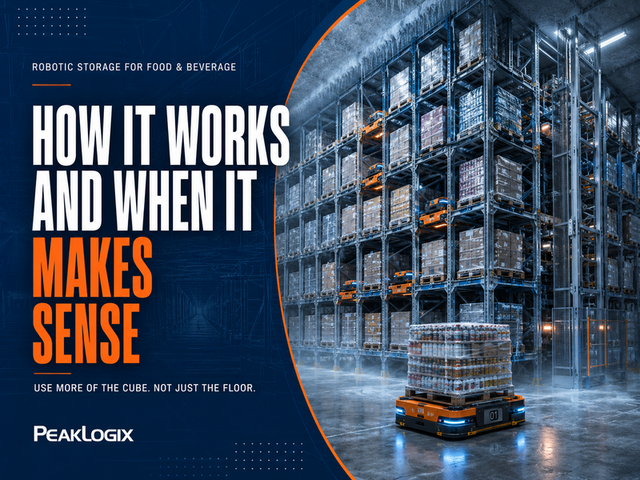
Robotic storage uses automated equipment to move pallets or cases through a high-density storage structure rather than relying on forklifts to access every storage location.
Depending on the application, robots or shuttles transport loads horizontally and vertically, automatically storing and retrieving inventory when the system requests it.
The result is a storage system that can use more of the facility’s available cube, not just its floor space.
This is particularly valuable for food and beverage operations, where refrigerated and frozen environments make every square foot more expensive to build, cool, maintain, and operate.
PeakLogix integrates automated and high-density storage technologies designed to address these environments, including solutions capable of operating in subzero temperatures.
Why Robotic Storage Makes Sense in Cold and Frozen Facilities
The economics of automation become particularly interesting when you’re paying to refrigerate the space.
Traditional pallet racking requires forklift aisles throughout a facility. High-density robotic storage can reduce that requirement and allow more pallets to occupy the same building footprint.
That creates several potential advantages.
More storage without expanding the building. PeakLogix has previously implemented semi-automated deep-lane storage for a food and beverage customer that increased storage capacity by more than 60%. In another freezer application, PeakLogix redesigned existing storage to increase pallet inventory by 40% and FIFO carton inventory by 50%.
Less dependence on freezer labor. Working in subzero environments is difficult, and recruiting and retaining employees for freezer operations remains a challenge. PeakLogix has identified freezer labor shortages as one reason food and beverage companies are increasingly evaluating automation.
Reduced forklift movement. When automated equipment handles pallet storage and retrieval, forklifts don’t need to travel into every storage lane. This can reduce traffic and create opportunities to minimize product damage and forklift-related risk.
Higher throughput potential. Instead of depending entirely on forklift travel time, automated systems can continuously retrieve and deliver pallets based on system demand.
How Does a System Like Geek+ SkyCube Work?
Solutions such as Geek+ SkyCube take a robot-driven approach to high-density storage.
Rather than creating traditional aisles so forklifts can access individual pallet locations, robots move within the storage system to retrieve and deliver inventory. That allows storage locations to be positioned much more densely while also making greater use of vertical space.
The concept is straightforward: bring the pallet to the operation instead of sending a forklift through the warehouse to find the pallet.
That same principle is behind many warehouse automation solutions integrated by PeakLogix, including AS/RS, automated storage, goods-to-person technologies, robotics, conveyors, and warehouse software.
When Does Robotic Storage Make Financial Sense?
Robotic storage isn’t automatically the right answer for every food and beverage facility.
The business case becomes stronger when several pressures exist at the same time:
- Cold or freezer storage space is approaching capacity
- Building expansion is expensive or impractical
- Forklift aisles consume significant usable space
- Labor availability or turnover is creating operational problems
- Pallet movement is repetitive and relatively predictable
- Throughput requirements are increasing
- The operation needs greater storage density without adding square footage
Before selecting technology, PeakLogix evaluates the facility, inventory, throughput, workflows, and business objectives. Its warehouse design process begins with operational data and uses that information to determine where conventional equipment, automation, or a combination of technologies can deliver the greatest benefit.
That’s important because the goal shouldn’t be to install robots.
The goal should be to solve the operational problem.
The Real Question: How Much Are Your Aisles Costing You?
For a conventional warehouse, an aisle represents lost storage capacity.
For a freezer, that aisle can represent something more: space you’re continuously paying to refrigerate without using it to hold inventory.
As energy, labor, construction, and real estate costs rise, food and beverage operators should evaluate whether the traditional forklift-and-aisle model is still the most economical use of their facility.
Robotic storage may allow you to store more product in the building you already have, reduce forklift travel, automate repetitive pallet movements, and create a cold storage operation that can scale without immediately adding more space.
The question isn’t whether robots belong in every freezer.
It’s whether your freezer could perform better with less space dedicated to forklifts and more space dedicated to product.
Could Robotic Storage Work for Your Food & Beverage Operation?
PeakLogix has helped food and beverage companies design and integrate material handling solutions for cold storage, production, distribution, and fulfillment environments for decades.
If space, labor, throughput, or freezer capacity is becoming a constraint, the first step is understanding where the biggest opportunities exist in your current operation.
Take the PeakLogix Warehouse Operations Assessment →
Or explore PeakLogix’s food and beverage material handling solutions to learn how automation, high-density storage, robotics, and other technologies can work together.
