As fulfillment and manufacturing operations face increasing pressure from labor shortages, rising customer expectations, and tighter shipping windows, warehouse automation has moved from a long-term idea to a near-term necessity.
When these conversations begin, many teams instinctively look upstream—storage, picking, or retrieval systems. In reality, some of the fastest and most reliable returns on investment often come much closer to the dock doors.
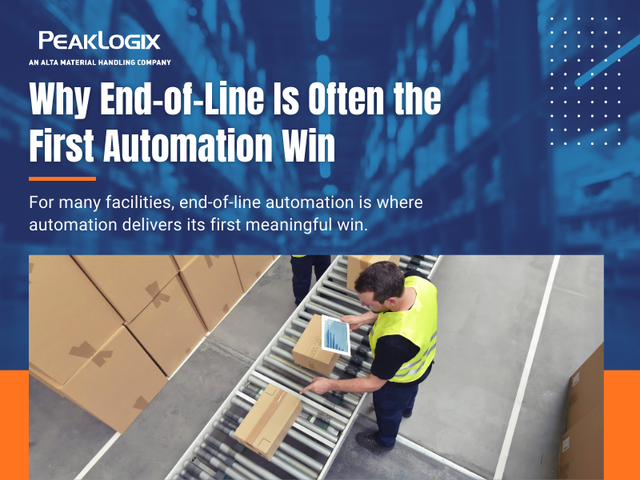
For many facilities, end-of-line automation is where automation delivers its first meaningful win.
What Is End-of-Line Automation?
End-of-line automation refers to the systems and technologies that handle products after they’ve been picked or produced, but before they ship to customers. This stage typically includes:
- Case erecting and sealing
- Automated or semi-automated packing
- Print-and-apply labeling
- Inline weighing and dimensioning
- Sortation to carriers or destinations
- Robotic or automated palletizing
These processes are often highly repetitive, labor-intensive, and time-sensitive—making them ideal candidates for automation.
For a deeper overview, see What Is End-of-Line Automation and Why It Might Be Your Best First Step.
Why End-of-Line Becomes the Bottleneck First
End-of-line operations sit at the intersection of volume, variability, and customer expectations.
As order profiles change and throughput increases, packing and shipping teams are often asked to absorb more complexity without additional space or labor. Carrier cut-off times remain fixed. Compliance requirements tighten. Small errors become costly.
It’s common to see upstream improvements—faster picking or higher production output—simply push congestion downstream. Packing stations back up, pallets accumulate near docks, and orders miss outbound windows.
This is why end-of-line processes are frequently the first visible constraint in a growing operation.
Why End-of-Line Automation Delivers Early ROI
High Labor Impact in Repetitive Roles
End-of-line tasks are among the most repetitive jobs in a facility. Packing, labeling, weighing, and palletizing require consistency more than decision-making, yet they consume a significant amount of labor.
Automating these processes can:
- Reduce manual touches
- Improve consistency across shifts
- Stabilize throughput during labor shortages
In today’s labor environment, reducing reliance on hard-to-staff positions is often as important as lowering costs.
Faster Implementation with Less Disruption
Compared to large-scale storage or picking automation, many end-of-line solutions can be implemented with minimal disruption to existing workflows.
Technologies such as print-and-apply labeling, inline dimensioning, or modular conveyor and sortation systems are often layered into current operations rather than requiring a full facility redesign. This allows teams to realize value faster and with lower project risk.
Immediate Visibility of Results
Improvements at the end of the line are easy to measure:
- Increased pack rates
- Fewer shipping and labeling errors
- Reduced carrier chargebacks
- More predictable outbound flow
These gains directly impact service levels and customer satisfaction, helping automation projects gain internal support.
Modular vs. Fully Integrated End-of-Line Automation
A common misconception is that end-of-line automation must be implemented all at once. In practice, many successful projects start with a modular approach.
Teams may begin by automating:
- Labeling to improve accuracy
- Weighing and dimensioning to ensure carrier compliance
- Sortation to streamline outbound flow
From there, systems can be expanded or integrated further as volumes grow and requirements evolve. This phased approach allows organizations to align capital investment with operational priorities while still designing for long-term scalability.
Avoiding Bottlenecks in End-of-Line Automation Projects
While end-of-line automation often delivers quick wins, it must be planned carefully.
One of the most common mistakes is improving packing or palletizing speed without considering upstream release rates or downstream carrier constraints. In these cases, automation simply shifts the bottleneck rather than eliminating it.
Successful automation strategies take a systems-level view of material flow—ensuring improvements at the end of the line are supported by upstream processes and aligned with outbound capacity.
PeakLogix explores this concept further in From the Dock to the Door: Connecting Fulfillment Automation to Your Supply Chain.
When End-of-Line Automation Makes Sense to Start
End-of-line automation is often a strong first step when operations experience:
- Labor challenges in packing or shipping
- Frequent mislabels or shipment errors
- Missed carrier cut-off times
- Congestion near docks or staging areas
- Growth that manual processes can no longer absorb
Stabilizing the final handoff to the customer can unlock improvements throughout the rest of the operation.
A Business Decision, Not a Technology Purchase
At PeakLogix, end-of-line automation works best when it’s treated as a business decision—grounded in throughput goals, labor strategy, and long-term flexibility—not simply a technology purchase.
When downstream processes are stabilized, upstream automation—such as goods-to-person systems—can deliver even greater value as part of an integrated material flow. Learn more about where to start with warehouse automation and how systems work together.
In an upcoming live webinar, we’ll take a deeper look at how operations teams evaluate end-of-line automation, where it makes sense to begin, and how to avoid the common pitfalls that limit ROI.