As Q4 closes and organizations begin mapping out capital plans for the year ahead, warehouse automation often re-enters the discussion. Labor availability remains uncertain, customer expectations continue to rise, and many operations are feeling the strain of systems and processes that were never designed for today’s demand.
Most leaders agree automation will play a role in the future. The challenge is determining how to plan for it financially—without guessing, overcommitting, or delaying the conversation altogether.
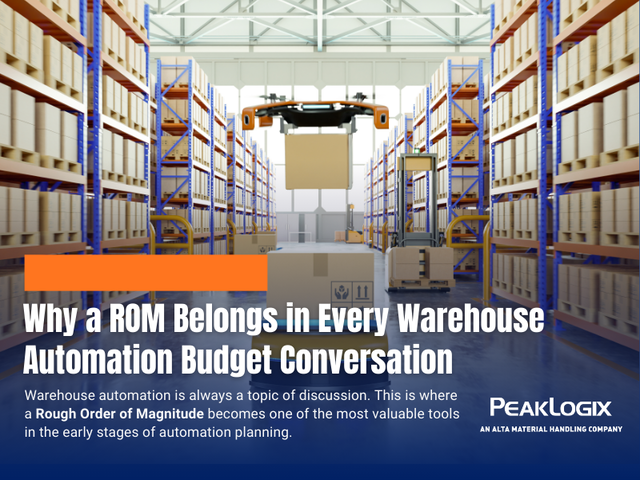
This is where a Rough Order of Magnitude, commonly referred to as a ROM, becomes one of the most valuable tools in the early stages of automation planning.
Rather than focusing on specific equipment or vendor pricing, a ROM provides a practical framework for understanding the scale of investment and potential return based on how a facility actually operates. It allows automation to be discussed as a business decision, not a technology purchase.
Moving Past Guesswork in Capital Planning
Automation initiatives often lose momentum because the numbers are unclear. Leadership teams are asked to consider significant capital investments without a reliable way to gauge cost, impact, or risk. Broad estimates and anecdotal examples rarely stand up to scrutiny in budget meetings.
A ROM addresses this gap by grounding the conversation in operational data. It offers a realistic investment range tied to order volume, labor requirements, throughput goals, and space constraints. While it does not represent a final design or a firm quote, it establishes a credible planning baseline.
This clarity alone is often enough to change the tone of the conversation. Instead of asking whether automation is “too expensive,” teams can begin discussing whether it makes sense relative to other strategic priorities.
What a ROM Is Really Built On
A meaningful ROM is not created in isolation. It reflects the realities of day-to-day operations and the pressures the facility is under today, as well as where it is headed.
Order profiles, SKU velocity, picking methods, labor costs, and facility layout all play a role in shaping both the cost and the value of automation. When these factors are understood, different approaches—such as Goods-to-Person systems, vertical lift modules, shuttle-based storage, or hybrid solutions—can be evaluated objectively rather than emotionally.
The result is not a recommendation to automate everything. In many cases, the analysis reveals that targeted automation or phased improvements can deliver substantial benefits without a massive upfront investment.
Why Q4 and Early Q1 Are the Right Time
Timing matters in automation planning. Late Q4 and early Q1 offer a rare combination of fresh operational data and active budget development. Peak season performance is still top of mind, and leadership teams are determining where to allocate capital for the year ahead.
Developing a ROM during this window allows operations and supply chain leaders to bring structure to those discussions. Even if automation is not approved immediately, the organization gains a clearer understanding of what future investment might look like and how it aligns with growth plans.
Just as importantly, it prevents automation from being deferred indefinitely due to uncertainty. A ROM keeps the conversation moving forward, grounded in facts rather than assumptions.
Enabling Smarter, Phased Decisions
One of the most common misconceptions about automation is that it requires an all-or-nothing commitment. In reality, many successful automation strategies begin with modest, well-defined steps.
A ROM often highlights opportunities to reduce travel, improve storage density, or relieve labor pressure without reengineering the entire operation. These insights make it easier to propose phased investments that deliver near-term value while supporting long-term scalability.
For leadership teams, this approach reduces risk. For operations teams, it creates a practical path forward rather than a theoretical future state.
Turning Early Analysis into Executive Confidence
Ultimately, the value of a ROM lies in confidence. It gives operations leaders a way to articulate not just what automation could do, but what it is likely to cost and why it makes sense.
When automation planning is supported by realistic ranges, clear assumptions, and a defensible return narrative, it becomes easier for executives to engage in meaningful discussion. The conversation shifts from speculation to strategy.
As organizations look ahead to the coming year, a Rough Order of Magnitude is not a commitment to automate—it is a commitment to plan intelligently. And in today’s environment, that may be the most important first step of all.
View the ROM Worksheet here.
